

Some projects begin with a script. Others begin with whatever happens to be available.
In twenty twenty-one, my friend Chava Montenegro called me about a project involving Caballeros del Plan G. They were preparing a symphonic concert with young musicians from DIME, and they needed a few filmed sequences to become part of the show.
There wasn’t much money.
There was, however, a sword.
Chava had been asked to make it.
There were also a few shields, some helmets, a couple of horses, and the idea of knights crossing the desert.
Apparently, that was enough.

I knew Caballeros del Plan G. Anyone paying attention to Mexican hip hop knew who they were. We belonged roughly to the same generation, although hip hop had never particularly been my world.
Then I met Felipe del Río.
We clicked almost immediately.
He told me what they were imagining, and I knew the desert where we could attempt it. I had explored the area outside Viesca for another project years before. I had never actually shot there, but I knew the territory.
So we went.

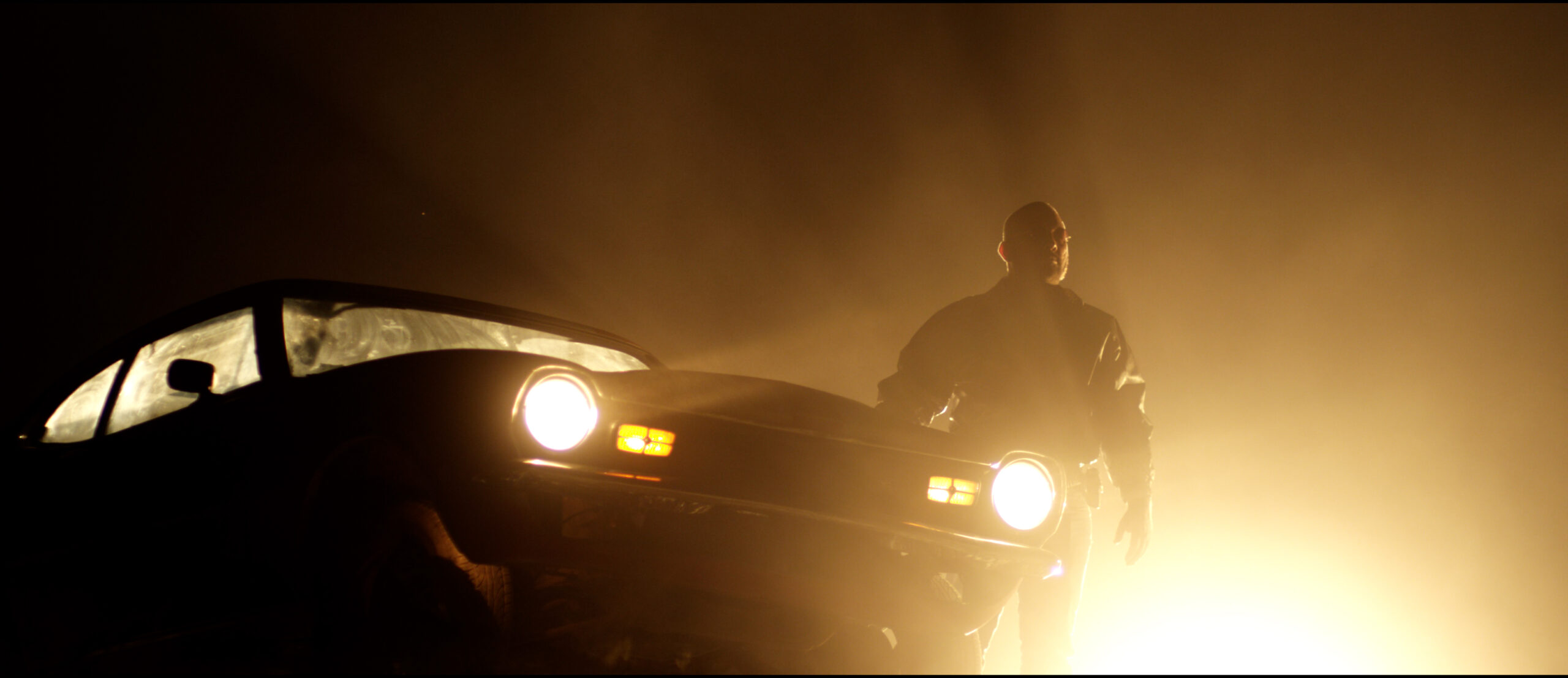
I brought my RED One, a few two-kilowatt tungsten Fresnels, some Kinos and whatever power we could reasonably manage. Somewhere back at the studio I had a ten K and a five K, but without the generators, crew or budget to move that kind of light through fifty or sixty meters of desert, they were meaningless.
So we used something considerably larger.
The sun. And when that disappeared, we used fire.

We had Chava drive a truck back and forth to throw dust into the air. We built fires. We carried wooden crosses into the landscape. We put armor on people and mounted riders on horses that perhaps weren’t exactly waiting for Ridley Scott to call.
They worked.
And that became one of the strange pleasures of the shoot.
Nothing was quite perfect.
But nothing felt forced.
At sunset, a hill we hadn’t planned for suddenly looked almost exactly like something Felipe and I had imagined. During magic hour, Chava became a blacksmith meeting a knight in the desert to deliver a sword and receive his payment.

At night we burned a cross. It became a beacon in the darkness.
And early the following morning, Viesca gave us one of those sunrises I knew it could give: deep red behind clouds and dust, before the sun itself had appeared. Against it, a knight buried the dead from a battle we had never actually filmed.
There wasn’t really a narrative.

There were fragments.
A sword.
A blacksmith.
A payment.
A battle.

The dead.
A cross.
Fire.
The audience could build the rest.

What had begun as a handful of images for a theater presentation was becoming something else.
We began wondering what else we could make.
There was another location.

Years earlier I had met Jorge Zarzosa through my friend Poncho Iduñate. Jorge was fascinated by the story of one of his relatives, Agustín Zarzosa, known as El Brigadier, whose role in Mexico’s independence he believed had never received its proper recognition.
For a while, the three of us imagined making a series about him.
It never happened.
Jorge died before we could make it.
But he had built an extraordinary house.
Stone walls. Different levels. Towers. Windows. Rooms that seemed to belong to another time.
When I eventually returned there with Caballeros del Plan G, the first thing I did was stop in front of Jorge’s photograph and thank him.
A film we had once imagined there had never existed.
Another one had somehow arrived.
The house became our castle.
We built the blacksmith’s workshop. Chava heated iron in the forge. A child worked beside him. A dog guarded the place. Friends became characters. Caballeros performed among the stone walls.

Again, it wasn’t perfect.
It was enough.
And enough can be an extraordinary amount when everyone agrees to believe in the same world.
Along the way, the project also introduced or reintroduced me to people who would remain part of my life: Andrés Herren, Rodolfo Sada, Javi Díaz, and others. Jorge, my gaffer, was also beginning to work with me during those shoots.
The project kept growing.
Then, as projects occasionally do, it hit problems.
Production circumstances, image rights and agreements forced us to rethink some of what we had shot. The blacksmith remained part of the material created for the theater, but for the music video we needed another solution.
So the blacksmith became a magician.

Which meant going back to the desert.
And somewhere around that point, Felipe and I apparently developed a dangerous habit:
Since we’re already here…
Since we’re going back, why don’t we shoot this?
Since Caballeros are coming, why don’t we shoot some playbacks?
Since Felipe had another song about to come out, why don’t we make something for that too?
That song was Misión Cumplida.
So we returned to Viesca.
This time it was February.
It was so cold that sitting inside the car didn’t particularly help.
We put Javi on a rock I loved. We carefully lit fires. People swept the ground with branches to send dust into the wind. Caballeros performed in the desert at night.

And once again, somehow, the place became larger than what we had brought into it.
Only later did I fully appreciate the strange position in which I had landed.
La Remezcla belonged to a history that had begun roughly twenty years earlier. A song from another moment in the life of Caballeros del Plan G was finally finding its images.
At almost the same time, we were filming Misión Cumplida, a song about closing a cycle.
One piece was looking backward.
The other was saying goodbye.
And I had arrived somewhere in between. Felipe and the guys sometimes made me feel as though my participation in all of this was something extraordinary. I never quite saw it that way.
Sometimes I felt more like a fly riding on the back of a horse that had already been galloping for twenty years. The fly may be visible. But the horse is still the one doing the running.
Caballeros had built that road long before I arrived. I simply had the privilege of traveling a small part of it with them, carrying a camera.
And perhaps that is why I remember those nights so fondly. A freezing desert. A few lights. A RED One that felt increasingly heavy on the stabilizer.
Fire, dust, friends sweeping the ground with branches. A man standing on a rock.
Twenty years of music somewhere behind us.
And all of us asking the same dangerous question:
Since we’re already here…
What else can we make?

Mino Rimada