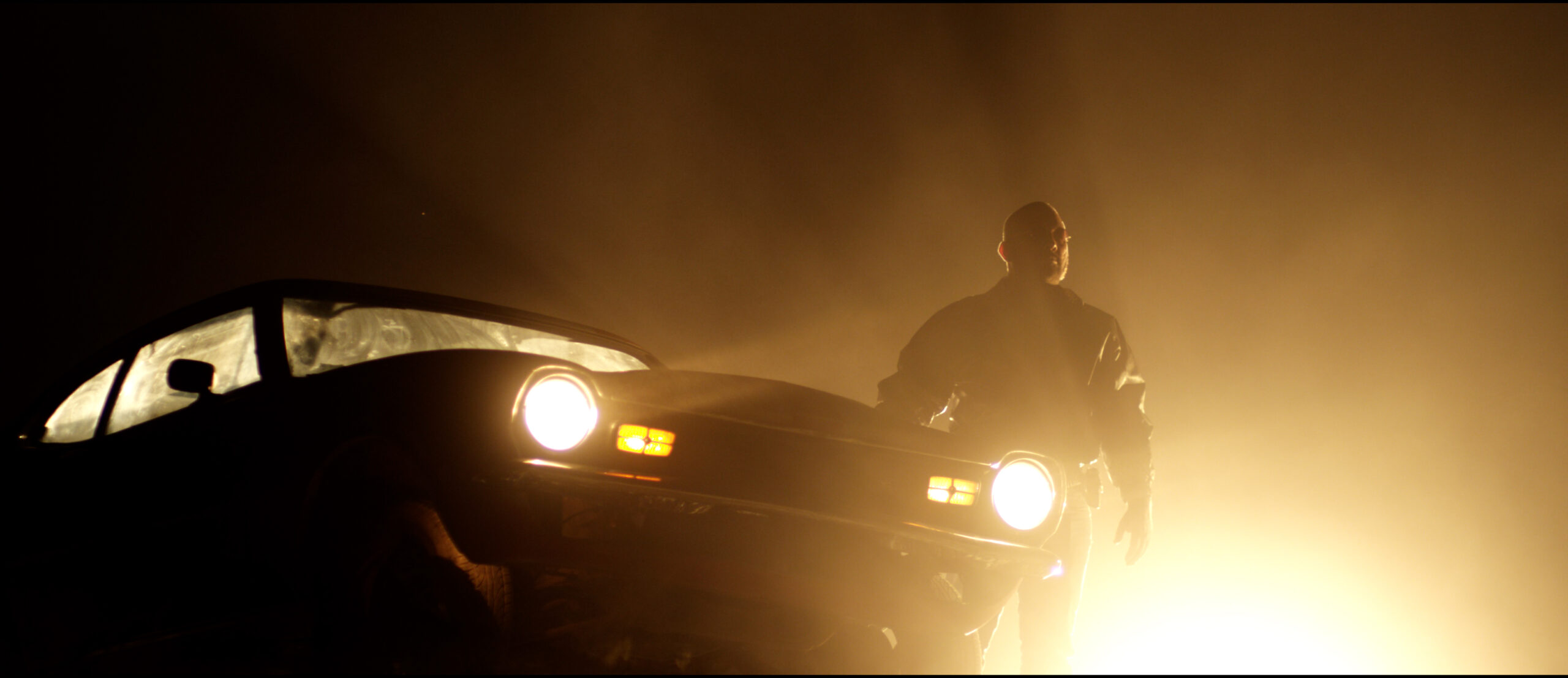


When Felipe del Río, Doctor Alacrán from Caballeros del Plan G, called me about Te voy a matar, we already knew each other well.
We had worked together on Misión Cumplida and La Remezcla, and somewhere between those shoots and the conversations around them, a friendship had begun to form. Felipe was also returning to something more personal: Doctor Alacrán, a character and musical identity he had been developing outside Caballeros.

This song was for the haters.
Not quite as murderous as the title suggests. In Spanish, “te voy a matar” can become something else when followed by two words: de coraje. To make someone furious. To drive them mad.
The idea was appropriately ridiculous.

A hater spends his time attacking Doctor Alacrán online. Eventually, Alacrán and his people decide to give him a dose of his own medicine. They kidnap him, put him through an increasingly absurd ordeal, and eventually release him in the middle of nowhere. When he thinks he has finally escaped, he asks the first person passing by for help.
It is Doctor Alacrán.
Felipe had another idea.
“Why don’t we shoot it on a phone?”
I wasn’t immediately convinced.

I have never believed that cameras don’t matter. They do. If people have taken the time to perform, build, light, dress and prepare something in front of a lens, part of me feels responsible for recording that work with a tool capable of honoring it.
But there was another question hiding underneath that resistance.
Is it the camera, or is it the monkey behind it?
So we decided to find out.
An iPhone fourteen. A stabilizer. A few lights. A small group of people. Nothing particularly elaborate.
And then we started playing.
The location gave us an old workshop, cars, brick walls, a van and a service pit that immediately became our little version of hell. We pushed hard tungsten through smoke. We threw red across walls. We played with frame rates, extreme wides, movement and color without worrying about whether any of it was too much.

Too much was exactly the point.
At night, I placed a hard red light so that the dancers cast enormous shadows across the wall of the building and over the cars. We only had a couple of bodies in front of the camera, but suddenly their shadows multiplied them. Two people could occupy an entire building.
It reminded me of something very old about cinema.
A shadow doesn’t need to be realistic. It only needs a wall.

Inside the van, the wide lens could get uncomfortably close. Faces distorted. Bodies crowded the frame. Green collided with magenta and red. Instead of trying to make the phone behave like a larger cinema camera, we increasingly allowed it to behave like itself.
And somewhere along the way, the question about the camera disappeared.
There were people tied up in vans, masked women with baseball bats, smoke pouring through a workshop, Doctor Alacrán performing from the bottom of a pit, food scattered beside a road, and my children accompanying me for part of the scouting and the final exterior shoot along the Nazas.
At one point, we even managed to bury the truck in a bank of sand.

That wasn’t in the treatment.
Looking at the images now, of course there are moments when I wonder what they would have looked like with another camera. Today I could put a Blackmagic on a Ronin and move with almost the same freedom while capturing a very different image.
Maybe it would look better.
But it wouldn’t be this.
And perhaps that is the part of the experiment I still find interesting.
The limitation wasn’t something we defeated. It became one of the rules of the game. Once we stopped protecting the image, we started throwing things at it: harder light, stranger angles, bigger shadows, more color, more movement.
We weren’t trying to prove that an iPhone was a cinema camera.

We were trying to make Te voy a matar.

And we had a hell of a good time doing it.
Mino Rimada