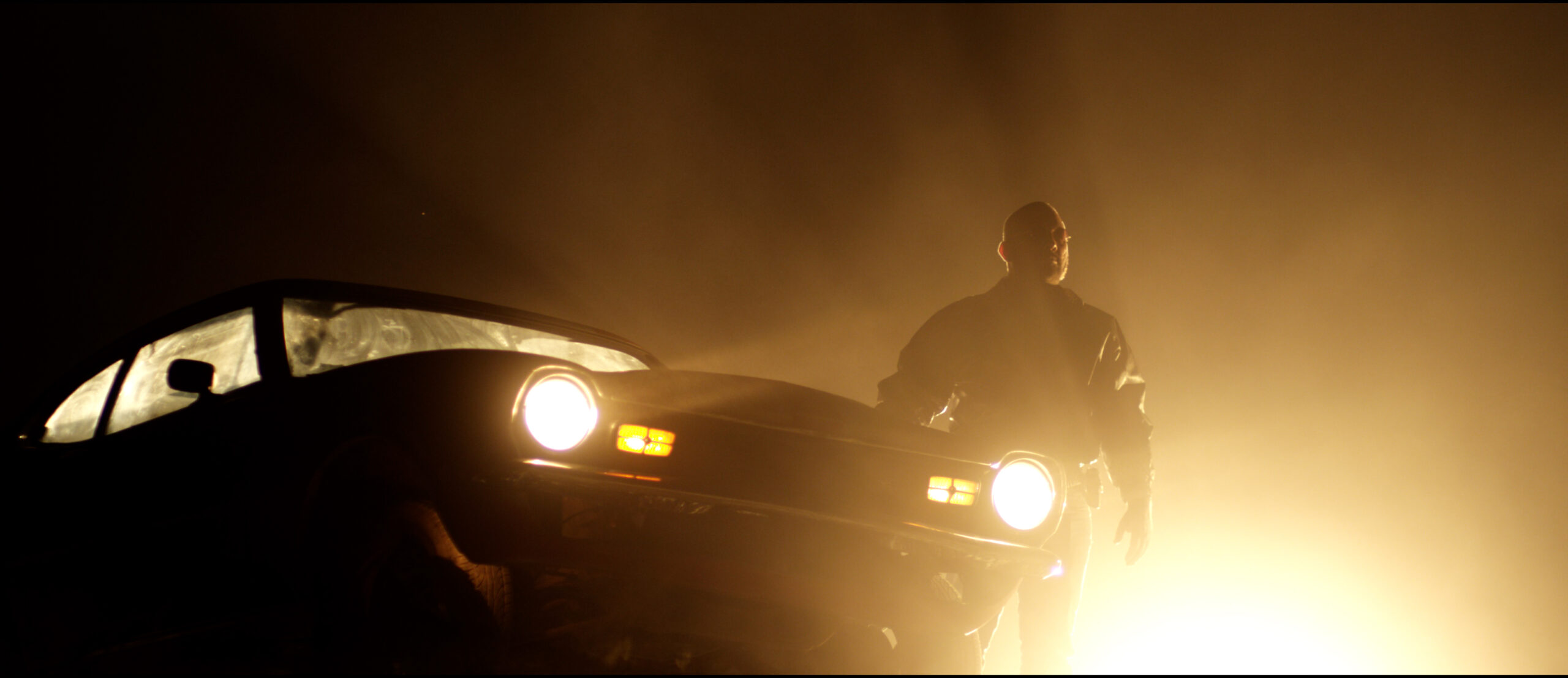


In two thousand seventeen, I was working for a client in Mexico City when I started receiving messages from a guy in Cambodia. Manish.
I didn’t know any Manish, so at first I thought, what the hell is this?.
But he kept trying to reach me. Eventually I realized he had seen one of my short films and wanted me to be the Director of Photography for his first feature, a biopic supported by the Cambodian government.

And immediately I remembered something. When I was young, I saw Seven Years in Tibet, and I remember seeing Jean-Jacques Annaud making this film on the other side of the world. I thought, man, imagine traveling that far with a crew to make a movie.
And suddenly, years later, someone was asking me to do exactly that.
I was scared to death. But I didn’t think too much about it. I just thought, I f***ng want to do this.
One of my first questions was: can I bring people with me?
Because part of what I was trying to do with Alcayata Films, my production company, was create opportunities of experience for people back home, where there was practically no film industry.
So Ángel Oviedo joined as still photographer and my AC. Then in Vancouver we learned they were having trouble finding a makeup artist, Ángel knew Claudia Samaniego, who was studying there, and somehow she joined too.

My cousin Emmanuel Navarrete also came for the first couple of weeks to help us organize the production. We brought some of Alcayata’s lenses and audio equipment, and suddenly this thing was becoming ours too.

When we arrived in Phnom Penh, everything was completely different. I come from northern Mexico, from wide streets and desert, and suddenly there were hundreds of motorbikes everywhere. I learned very quickly that crossing a street in Cambodia is basically an act of faith.
But something strange happened. The place was completely foreign and, at the same time, the people didn’t feel foreign at all.
The actors, the crew, everybody treated us incredibly well.
For the first couple of weeks, Emmanuel and I worked with Manish organizing the production, going through the script, making call sheets, scouting locations. For me it was about knowing the beast. Learn the spaces. Learn the light. Learn the people.
And then came the first shooting day.

Everything looks damn great on paper.
Then you start shooting.
We had professional equipment, gaffers, lighting, locations, government support… and at the same time, people were doing three different jobs.
Someone could be grip in the morning and cooking lunch a few hours later. We had Korean, Khmer, English, Spanish, Thai… sometimes nobody knew what the fuck anybody else was saying.

The first days were stressful as hell. Police would suddenly arrive at night because somebody hadn’t communicated a permit. One of the gaffers might be hunting bugs around the lights to eat them later. Something was always missing.
But eventually we found the rhythm.

Wake up early. Drive to the location. Shoot all day. Finish late. Repeat.
And I began recognizing something familiar. This was guerrilla filmmaking. Do the best you can with whatever you have.
The sports village became this enormous set for us. Construction barracks became an army camp. Athletes became actors. Locations became whatever the story needed them to be.

And whenever something was missing, Manish had this phrase:
‘I will arrange.’
We need something? I will arrange.
We don’t have an actor? I will arrange.
One day we needed a burglar for a scene and we had no burglar. So Manish literally walked out to this dark road and waited.

Some poor bastard comes along on a bike.
Manish talks to him, offers him a few dollars, and suddenly this guy who was probably just going home is in our fucking movie. Five minutes later Claudia is putting makeup on him so it looks like the girls in the film have beaten the shit out of him.
I still wonder what that guy told his family when he finally got home.
We shot into Kep and Kampot, and Cambodia changed completely again. Everything was green. Rice fields, bamboo, lotus ponds, tamarind trees, water buffalo. I’m a desert guy. This was another planet.
And I fell in love with it.

But filmmaking there was brutal. We had a generator, some lights, whatever daylight gave us, and a schedule that didn’t give a shit. One day we shot something like twenty-seven scenes.
Eventually we returned to Phnom Penh. The schedule had stretched, everybody was tired, and we still had some of the hardest material ahead of us.
For one sequence we transformed those construction barracks into a military camp. We had villagers as extras and somehow production managed to get nine real Kalashnikovs.

That was a very interesting night to remain fucking awake.
And eventually, I came home.
When I was young, I imagined what it would be like to travel to the other side of the world and make a movie.

Cambodia gave me the answer.
It wasn’t the romantic version I had imagined.
It was exhaustion. Bugs. Missing actors. Twenty-seven scenes one single day. Four languages at the same time. Police arriving at night. People cooking between setups. Arguments. Friendship. Beautiful light. And a guy on a bike who unexpectedly became an actor.
And after all of that…

I still wanted to make films.
We used to call it Cambollywood.
And I think, in some strange way, it was a test.
Not of whether I could make a film.
But whether, after seeing what making one could actually be, I still wanted this life.
Apparently, I did.
Mino Rimada