

Una Noche no Me basta
When Emmanuel Navarrete and I first met Simón León, we were actually hoping to invite him to take part in another project. But the conversation ended up going the other way around. Simón had already seen some of Alcayata’s work, and he was the one who asked us: “So, what can we do together?”

The project was a music video for Una noche no me basta, a song written by Bruno Danzza and performed by Simón alongside Shaila Dúrcal. They wanted to do something different. It was a beautiful, quiet, romantic song, and from the beginning there was the possibility of taking it to Parras and building something around its vineyards and wine culture.

There was an inevitable reference to films like A Walk in the Clouds, but I didn’t want to simply create a collection of beautiful images to accompany a song. I wanted to tell a story.
That was how the idea emerged of a boy who has to leave home.
There is a small exchange in the film that I still love. Someone tells him that they are no longer wanted on the other side of the border, and the boy answers, “Well, they don’t want us here either.”
When my father saw that scene, he told me that line hit hard. I think he understood exactly what was behind it.
Because that was really the story I was interested in. The story of many Mexicans who have the will and the ability to build something, but at some point feel they have to leave in order to do it.

What happens when one of them comes back?
Years later, our character returns and, with whatever means he has, buys a small vineyard and begins building the dream he imagined as a boy. And in returning, he also encounters the love he left behind.

At the time, Una noche no me basta was one of the largest productions we had undertaken at Alcayata.
Through friends such as Heriberto Méndez and other contacts, we were able to reach actors including Hernán Mendoza and Héctor Bonilla.
But there was another intention that was equally important to us.
Since our earlier projects, we had been trying to bring together experienced industry professionals with actors, crew members, suppliers and local talent from La Laguna and Parras, at a time when the filmmaking ecosystem in the region was still beginning to take shape.

Rivero González, La Casona del Banco, Las Pudencianas and Hacienda El Perote opened their doors to us.
Parras didn’t end up being simply a location. It became part of the film.
The production lasted around four days. People traveled from Torreón, others arrived from different places, and eventually everyone converged in Parras. Because of that, a significant part of the work happened before we ever turned on the camera.
I tried to concentrate several scenes within the same locations and, whenever possible, even shoot where the principal actors were staying. It is a way of working I have repeated many times since: remove as much stress as possible from the production so that the energy can end up where it belongs, in front of the camera.
The nights were cold and the days were intense. The vines were only beginning to show their first shoots, and the video had to be finished for April.

Little by little, the production found its rhythm. We left some of the more complicated sequences, particularly the stunt work, until the end.
And when those days were finally over, something happened that I remember very clearly:
Nobody wanted it to end.
Visually, I didn’t want to invent a place that was already beautiful.
The Coahuila semi-desert has its own light and its own palette. Adobe, earth, blue skies, small traces of green appearing among the vines.

We shot on the RED ONE with Zeiss lenses. It is a large, heavy camera and sometimes an impractical animal, but I knew it extremely well. There is a texture to its image that I have never found surgically perfect, and that was precisely why it worked for this story.
I wasn’t trying to reproduce any particular film stock. I was looking for something of the warmth I remembered from certain romantic films of the seventies.
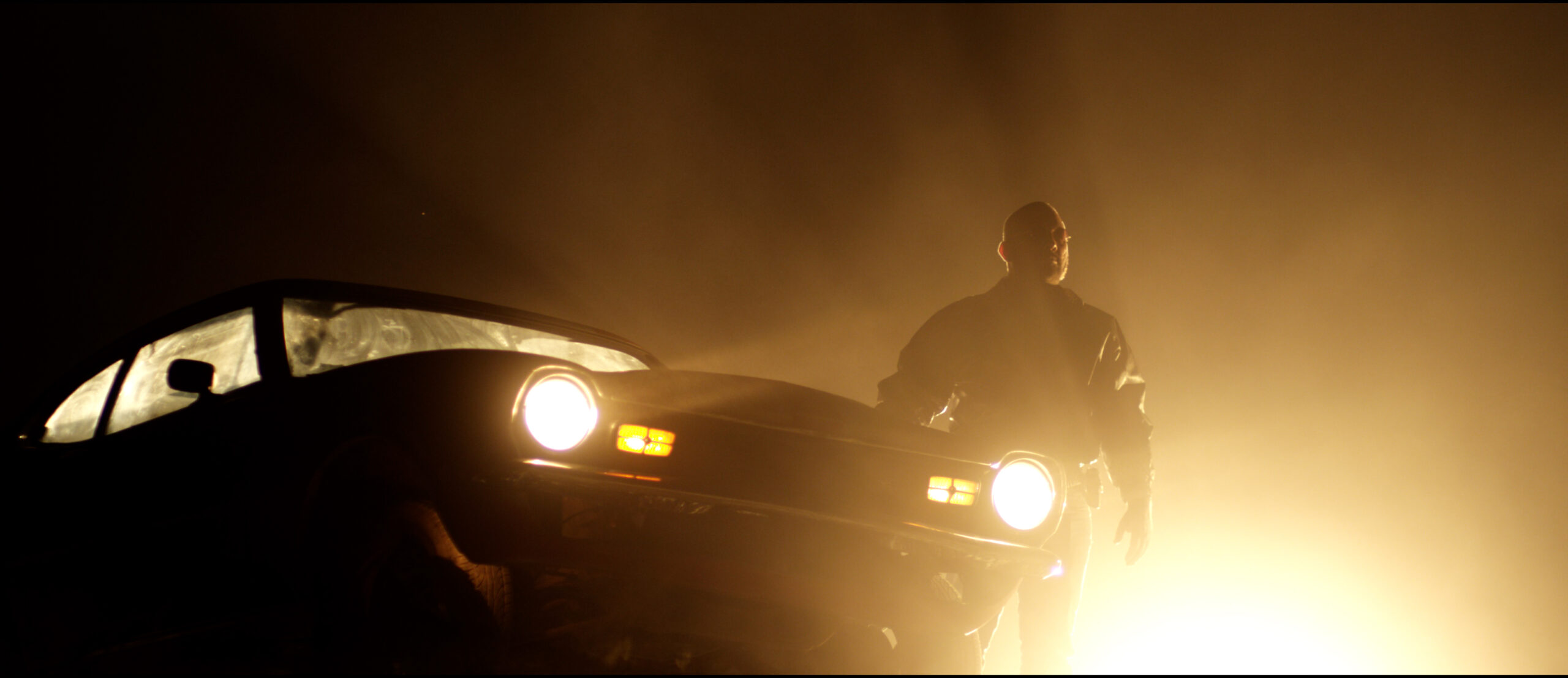
There are two scenes that, for me, still summarize the cinematography of Una noche no me basta.
One is the final encounter between Héctor Bonilla, Simón and Shaila at the small vineyard. We shot it between five and six in the afternoon. The sun was falling behind them, creating this beautiful backlight against the adobe, a red truck, the blue sky and the green of the vines.
Almost everything we needed was already there.
The other happens at night. Simón and Shaila are stomping grapes together in the vineyard. It may be an intentionally romantic image, perhaps even a cliché, but we decided to embrace it.
We threw tungsten light from a long distance to give the vineyard depth and texture, and it became one of my favorite scenes in the entire film.
The camera could move when the scene needed it, but I never wanted movement to become the protagonist. Often it was enough to leave the camera still or allow it a very subtle movement.
The scene came first.
The camera came afterward.
But what I remember most about those days isn’t technical.
I remember Brenda Castro, Heriberto Méndez, Jabo Banda, Linda Vargas and so many people from the region helping us build that world. I remember the openness of Shaila and Simón, and actors arriving to work on an independent, ambitious and, in many ways, still guerrilla production, and deciding to trust us.

Hernán Mendoza arrived while recovering from surgery. He traveled all the way to Parras, worked with enormous patience, and somehow still found time during a break to pull out his racing drones and get several of us flying them between the vines.
I wish I had had more time and more scenes with him.
He is one of those people who makes working together easy.
And I especially remember Héctor Bonilla.
For the younger generations working with us, watching him was a small lesson in what it means to be a professional artist. He took the work seriously, while remaining warm, funny and curious.
At one point he was surprised to discover that, besides directing, I was also operating the camera.
“The director? Wow. The director is operating the camera.”
That was simply how we worked.
Not because I have an obsession with doing everything myself. I have worked with cinematographers and much larger crews.
But when I have a very specific vision and I know I can execute it, I enjoy being behind the camera.
Héctor once told me that the way we were working reminded him a little of Sam Peckinpah.
Perhaps he recognized something in that more untamed, Lagunero, guerrilla way of making things.
I try to arrive on set having already built as many conditions in our favor as possible. I am not interested in repeating a shot twenty times hoping that something will eventually happen. I would rather prepare the space for something to happen, and then concentrate on the actor, the scene, and recognizing the moment when it finally does.
Perhaps that is why Una noche no me basta remains a project I care about so deeply.
My mother was there.
My aunt was there.
My crew, actors from La Laguna, people from Parras, local suppliers and actors with remarkable careers all shared the same small world for a few days.

At some point, Shaila described what we had made in much simpler terms:
“We made a mini movie.”
I think she was right.
But for me, it was also something else.
It was an opportunity to bring all those people together in one place and prove to ourselves that we could build something ambitious, beautiful and distinctly ours from right here.
And, in the end, Simón and us, were able to make something that could give something back to the we come from.
Mino Rimada