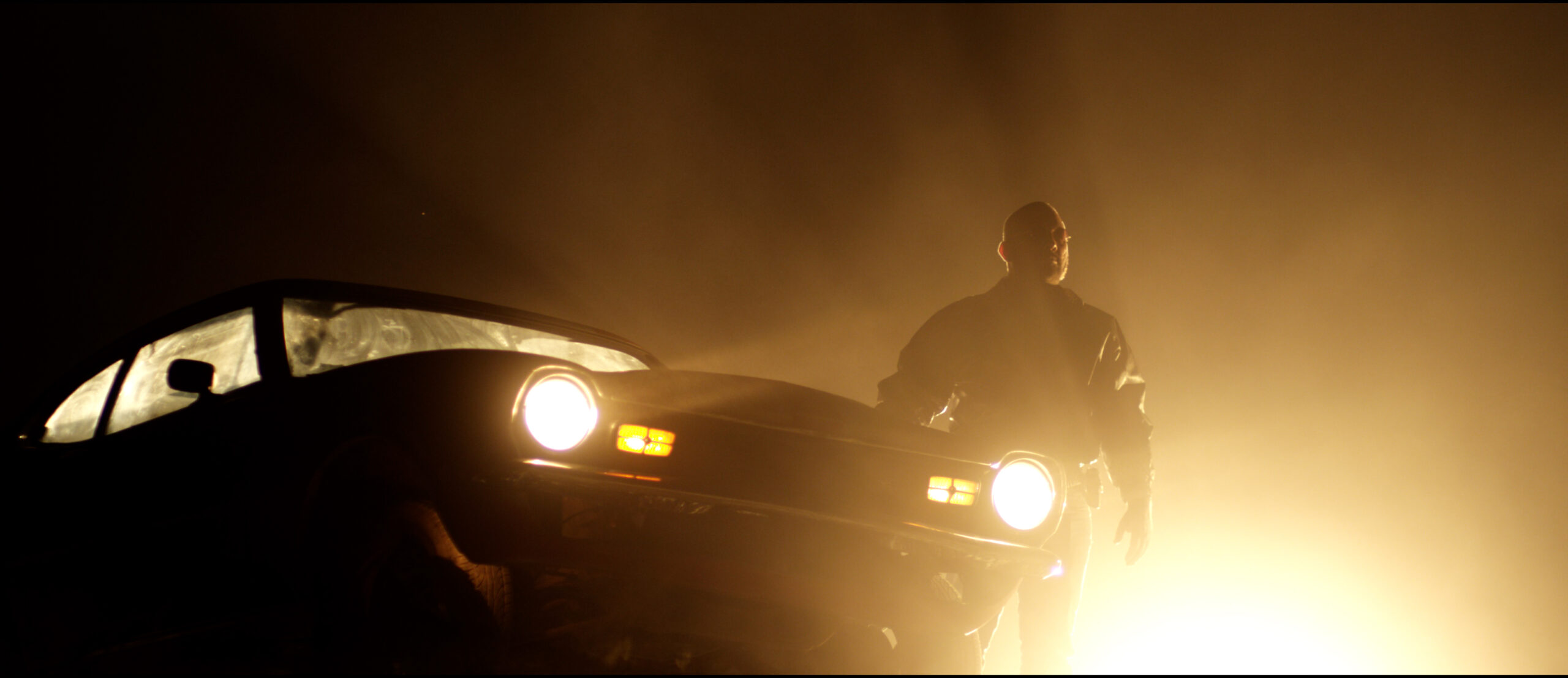


Snakes in Winter
After finishing Camino a Mala Noche, I wanted to do something completely different.
Camino had come from a story that lived in the desert. The landscape was a big player in the film. It wasn’t just where the story happened. It was part of the story itself. So, after finishing it, I wanted to see what would happen if I took all of that away.
Could I make something almost claustrophobic?
Could I take the same actor and put him in a completely different world and actually get something different from him?
That was the beginning of Serpientes en Invierno.
 It was during the pandemic, in the winter of two thousand twenty-two. I met actor Iván Carrum on a plane. He was coming to Torreón for a few days, and somehow the pieces started falling into place.

Around the same time, I visited my friend Rodolfo Sada at a place he had been using as a workshop. It was part apartment, part workspace, and he hadn’t really used it for filmmaking. But when I saw it, I immediately thought: this is the place.
It had layers. It had corners. It had a history without needing to explain what that history was.
I realized that I could transform this small space into an entire world and shoot the film in two days.
So that’s what we did.
There were almost no people on the crew. I was there with my camera, the actors were there, and Chuy Quiñones helped with a few things. That was basically it.
What I didn’t know at the time was that I was already getting sick with COVID.
I had spent so much of the pandemic being careful, staying home, trying not to get sick. And somehow, when I finally went out to make a film, I got it.
I didn’t really have symptoms while we were shooting. I just felt strange. It was a cold winter, the air was full of smog, and everything felt dense. We moved quickly because we only had those two days.
Afterward, I felt like hell, and fortunately, nobody else got sick.

That experience also became part of what I wanted from the film. I didn’t want to rush the story itself. I wanted the film to take its time.
I wanted to watch a man devastated by the memory of his wife.
Gabriel keeps calling her old phone number, even though the number now belongs to somebody else. The person on the other end keeps telling him to stop calling. His wife is dead. The line belongs to somebody else. The dead don’t answer the phone.

But Gabriel keeps calling.
For me, that was the heart of the character. He isn’t really trying to reach a telephone number. He’s trying to reach someone who is no longer there.
At the same time, he is trying to restore an old combi. He is surrounded by the memory of his wife, while his daughter, Ilse, is quietly trying to rescue him from that memory.
The story came from something very personal.
Something had happened in my family around the time I was writing it, and it made me think about how the work of an entire lifetime can sometimes end up in the wrong hands.
I decided to use real objects that had belonged to my grandfather and great-grandfather. These weren’t props I found somewhere. They were things that had actually belonged to my family.
The question became: what is really valuable?
And perhaps more importantly, who is capable of recognizing that value?
In the film, the answer comes from the person everybody is most likely to underestimate. Ilse, she is the child.
The adults are dealing with money, property, inheritance, careers and old resentments. They believe they understand what is happening. But Ilse sees something they don’t.
Sometimes we look at a decision and think it is the wrong decision because we are looking at it from our own perspective. And sometimes the person who appears to understand the least is actually the one who understands the most.
That became very important to me.
We also managed to shoot some scenes in a pecan orchard, which connected the fictional world directly to my childhood. I grew up visiting my grandfather’s ranch, and the sound of the woodpeckers in the trees brought something back to me immediately.

Those sounds weren’t something I designed, they were already there. And that’s one of the things I like about filmmaking, sometimes you don’t create the atmosphere. You find it.
There is another sequence in the film that comes from a completely different place.
We see Lore, Gabriel’s wife, in black and white. A car approaches from behind her. One of the kidnappers gets out and walks toward her. She remains completely calm, looking toward the camera, until the man finally touches her.
But what we are seeing isn’t necessarily what happened.
It is Gabriel imagining what happened. 
He doesn’t know. He wasn’t there. He is trying to reconstruct an absence.
That distinction became important to me: memory doesn’t necessarily reproduce reality. Sometimes it creates an image because we need an image to live with what we don’t know.

Visually, I wanted the film to move as far away as possible from the desert of Camino a Mala Noche. I wanted to take this tiny workshop and make it feel like it could exist anywhere.
Looking back, Serpientes en Invierno became an experiment in almost every sense. I came from the wildness of the desert and moved into a contained space.
I took an actor I had already worked with and put him somewhere completely different.
I found a workshop and transformed it into a world.
I took objects from my own family and gave them another life inside a fictional family.
I tried to make a film that moves slowly while making it in only two days.
But perhaps the biggest thing I discovered was that making the world smaller didn’t make the story smaller.
It made the invisible parts easier to see.
The memories.
The things people don’t say.
The things that remain after somebody dies.
And the strange possibility that sometimes the person we underestimate is the one who has already understood everything.
Mino Rimada