

Camino a Mala Noche
A filmmaking adventure into the heart of my homeland.
Around early 2020, I had been thinking about what happens to people when they are pushed into a difficult night.
There are moments when pressure strips away whatever we have built around ourselves. Something shifts. We finally see what was already there.
That idea became the seed of Camino a Mala Noche.
The story was simple: two men travel into the desert to collect an old tax debt from Don Chema, a man who has spent most of his life learning the rules of that territory. I have always been interested in stories where different forces collide, where two positions seem irreconcilable and a third becomes the weight that eventually tips the scale.

At first, I imagined shooting the film around Viesca, Coahuila, on roads and landscapes I already knew. Then I invited my friend Salvador Montenegro to play one of the characters.
“I know a place,” he told me.
He took me to Mala Noche.
We drove deep into the dry Laguna de Mayrán, into a landscape that somehow felt familiar even though I had never truly been there before.
My father used to tell me stories about my grandfather traveling through that desert.
I had grown up near it. I knew its light, its sky, its heat and the peculiar silence of the Laguna. But I had never traveled that far into its interior.
For the first time, I felt I had reached the heart of my own land.
And the film had found its home.
 Salvador already had a close relationship with the people of Mala Noche. Over the years he had brought different productions into the area, creating opportunities for local people to participate. Through him, what could have remained simply a beautiful location became something else: a community willing to receive us.
Then, during the pandemic, the Secretaría de Cultura de Coahuila announced a filmmaking grant.
It wasn’t a large amount of money. But in the desert, a single drop of water can make something bloom.
I submitted Camino a Mala Noche.
We got it.
At almost the same time, another film was taking shape nearby. My friend Óscar Troyo had received support for his short film El canto de la cigarra, on which I worked as co-producer, cinematographer and post-production supervisor. We shot it near Paila, only a few kilometers from the territory where I would later make Camino a Mala Noche. After finishing the shoot, we traveled to Churubusco for post-production.
Then we came home and changed places.

Óscar stepped in front of my camera as one of the principal actors in Camino a Mala Noche.
I have always thought of those two films as brothers.
For Camino, I gathered a small group of friends and collaborators: Salvador Montenegro, Chuy Quiñones, Israel Macías, Arturo Michel, Israel Frost and others who were willing to disappear into the desert with me for several days.
That mattered.
We weren’t taking a conventional production unit into Mala Noche. There were only around seven of us, and everybody had to become part of the crew.
December in the desert can be unforgiving. Warm days collapse into freezing nights. Locations can be fifteen or twenty kilometers apart. There are no stores around the corner, no production trailers waiting beyond frame.
So I prepared carefully.
Food, water, transportation, a large cooler, even a menu for each day. We would cook wherever we happened to be shooting and move across the desert according to the scenes and the light.
The preparation wasn’t an attempt to control the place.
It was precisely what allowed us to stop trying to control it.
I trusted the desert to become my co-director.
I know that landscape. I know its sky. I know its light. And I know how the desert can kidnap you and force you to walk at its own pace.
When we finally traveled roughly forty kilometers into the Laguna de Mayrán, Mala Noche welcomed us with something wonderfully ordinary: pan francés lagunero with avocado and sardines.

The people of the town gave us a classroom in their school where we could sleep. It was a large room with a broken window through which the wind would enter around four in the morning and freeze your head.
As for showers…
We don’t talk about showers.
You heated a bucket of water and waited your turn in the school bathroom.
That was home.
Our first scene was a single shot, where the characters hear the legend of the Indian and the cave. It was a perfect way for everyone to find the rhythm of the film.
After that, things began to unfold almost organically.

We moved. We ate wherever the day found us. We chased goats. We waited for light. We drove across enormous stretches of nothing and tried to arrive at the right place at the right moment.
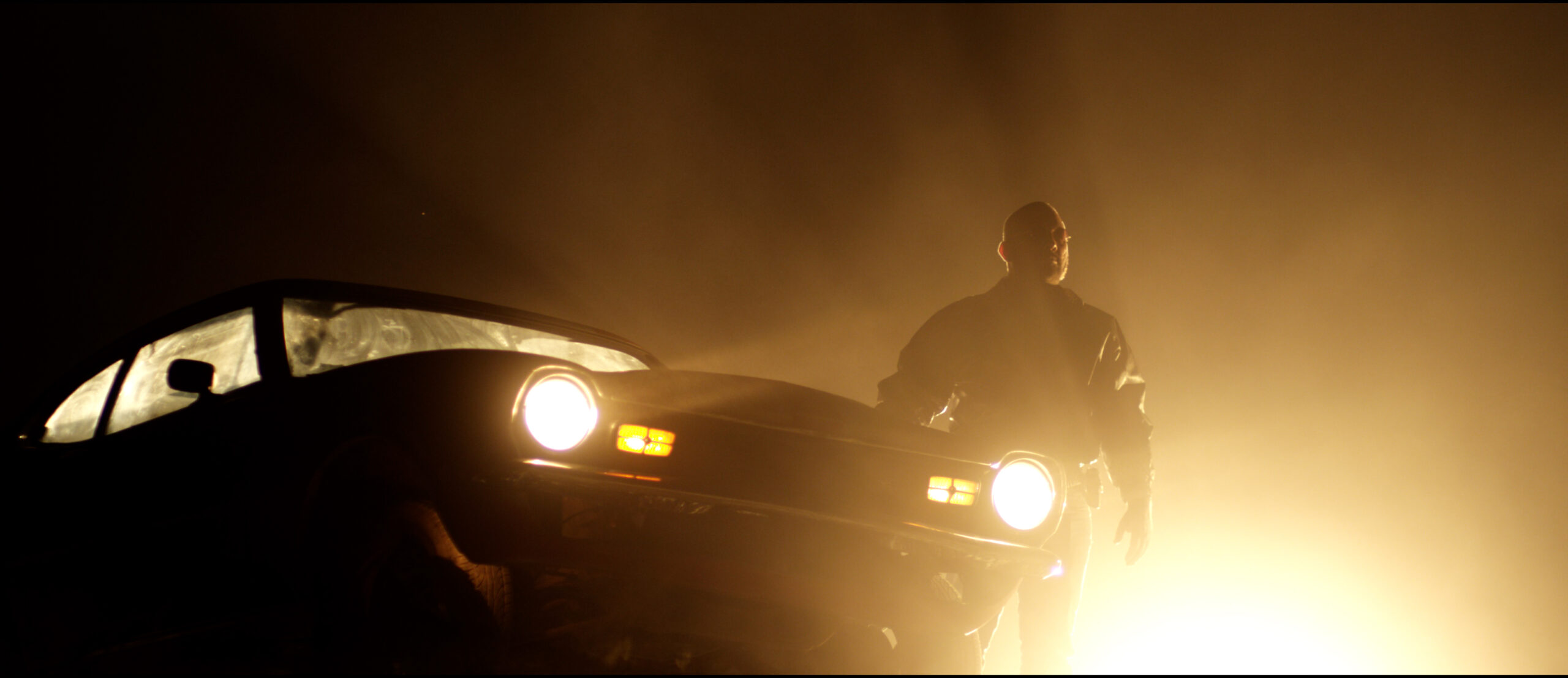
Even our picture car decided to participate.
The car was supposed to break down in the story.
Then it actually broke down and remained that way for the rest of the shoot.
Method acting, apparently, is not limited to actors.
On the first day, Arturo Michel asked me about makeup.
I told him not to worry. “The place is going to work on you.”
And it did.

Day after day, Mala Noche slowly began shaping everyone.
Dust settled into clothes and faces. The sun worked on our skin. The cold worked on our bodies. The wind followed us through the nights. Local people stepped into the film and brought with them a reality we could never have manufactured. At the paila, smoke from the extraction of candelilla filled the air.
The landscape was doing production design.
It was doing makeup.
And eventually, it began doing something to the actors.

By the time we reached one of the final night scenes beside the fire, several days of exhaustion had accumulated in everyone. The emotions the scene required no longer had to be summoned from nowhere. Something had already been prepared by the experience itself.
The desert had done its work.

When that first part of the shoot ended, we drove back alongside the dry lagoon towing Chuy’s broken car behind us. We carried dust, exhaustion, inconveniences and the peculiar satisfaction of having allowed ourselves to be swallowed by the place for a few days.
Later, Salvador and I returned.
There were still pieces the film needed: additional scenes and sounds, local people gathering candelilla in the mountains, small fragments of life that belonged to the territory.
And later I filmed my own daughter playing young Sara, Don Chema’s daughter, with the violin.
Looking back, I am deeply grateful to everyone who entered that desert with me, to Salvador for taking me there in the first place, and especially to the people of Mala Noche for opening their town to us.
But perhaps what remains with me most strongly is something harder to plan.
I have come to believe that when we surrender to creation with humility, something opens.
Synchronicities appear. Accidents become possibilities. People arrive. Places answer. Unexpected gifts present themselves.
Not because we commanded them.
Because we were present enough to witness them.
Sometimes that gift is light falling exactly where you needed it.
Sometimes it is wind moving through the desert.

And sometimes it is a group of damn goats wandering into your frame.
There are moments behind a camera when the only thing left to do is stop trying to create, sit quietly, and experience what has appeared in front of you.
Camino a Mala Noche began as a story about what might happen when a difficult journey forces someone to open his eyes.
Years later, I realize that perhaps the journey was doing the same thing to me.
Mino Rimada