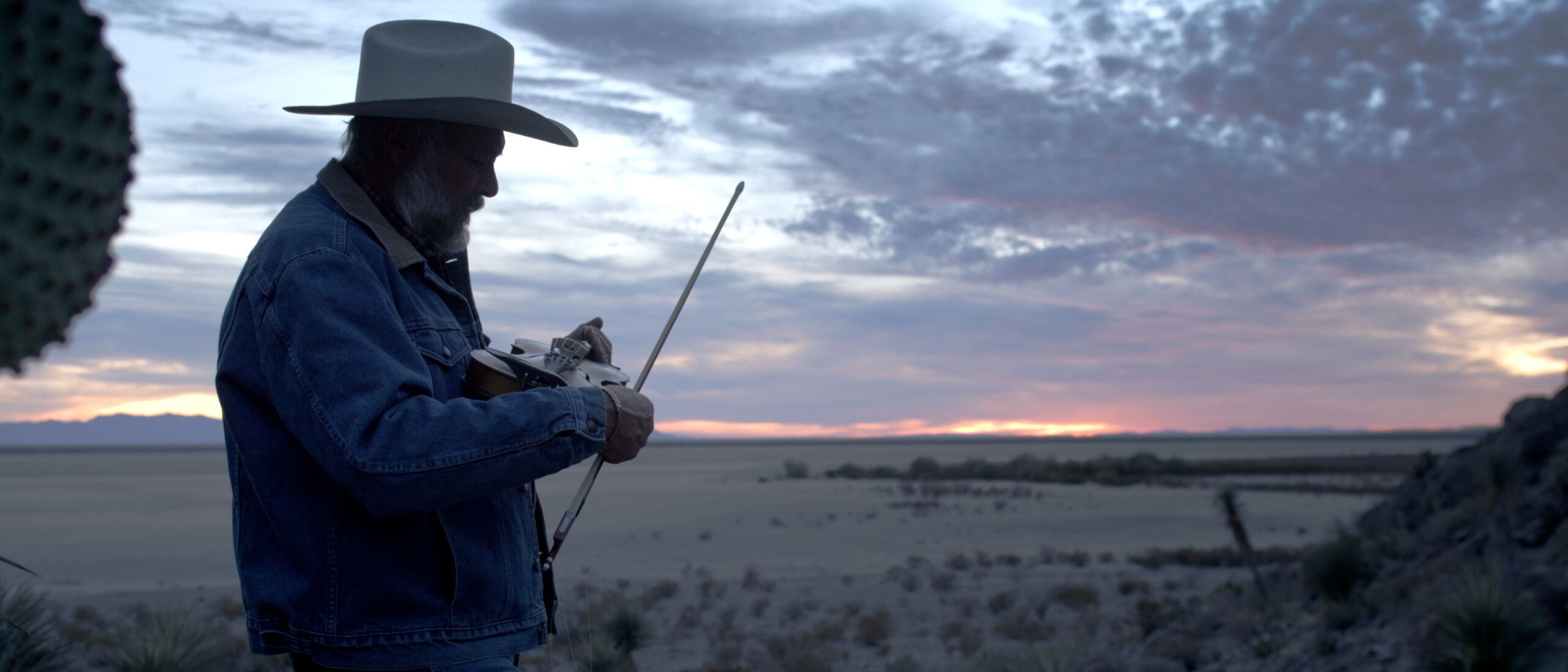


The Unholy Blessed is one of the most significant short films I’ve made.
It was my first time entering a forty eight hour film challenge. When I learned about AGBO’s No Sleep ’til Film Fest in 2022, I immediately got hooked. But instead of staying in the city, I decided to go somewhere that could work almost as a blank canvas, away from the noise and comfort of the city.
There is something I know well: the desert. The sun of my region, the white sands, the blue sky, the nothingness.
So I invited a small group of people I felt close to, people I resonated with, and we went into the desert without knowing what the challenge would be.

Four of us arrived first and camped there. The prompt was coming out around 7 pm that day, but there was one small problem: there was basically no internet or cell service in town. I eventually managed to find what seemed to be the only computer with a working connection.
A woman named Armandina kindly let me use it, that was where I finally discovered the challenge: combine at least three genres into a single short film.
So I drove the fifteen kilometers back into the desert with that in my head.
Since I was a kid, I’ve been in love with Westerns. That DNA is embedded even in the name of my production company, Alcayata Films, which comes from the railroad spikes. But I’ve also always been drawn to Mexican rural legends, supernatural forces, desolation, and the image of a kid standing alone in the middle of nowhere, confronting something much larger than himself and trying to figure out how to survive it.
That became the DNA of The Unholy Blessed.

A kid trying to escape the men hunting him. A red bicycle moving through a landscape of white and blue. An old Maverick crossing the desert. Darkness, headlights, hills, dust. A spirit. A deal.
My own son became that kid.
My friends became the crew and the actors. And one of the most beautiful things I remember is that nobody complained.
Everybody was completely entregado to the film.
We began during the night and kept going into next morning. The sun came up. It became hot as hell. We kept moving from one place to another, shooting whatever we could. Nobody quit.
And then the desert gave us something. In the middle of nowhere, we found the carcass of a horse. It was there in the right place, in the right position, in exactly the right moment. We could never have planned it.
I’ve always believed that one way of co-creating with the universe is to surrender enough to notice what it is offering you. So we took the carcass as a gift.
It became the threshold of the film: my son crossing through the ribs of that dead horse, walking toward a car driven by a spirit, about to make a deal that might save him from the men hunting him.
It remains one of my favorite images I’ve ever made.
But perhaps what I remember most from the production is the connection between all of us.
Franco, Fanny, Javs, Roberto, Chuma and Uriel, Jesus, my wife supporting us, my gaffer Jorge Eduardo, and everyone who became part of that strange little expedition into the desert.
There were moments when I would have something in my head and, before I could even explain it, somebody was already working on it. I would see Chuma preparing an action or working on the terrain almost exactly as I had pictured it.
It felt almost telepathic.
Today that memory carries another weight because Chuma is no longer with us.
Looking back, I think The Unholy Blessed was not only about a kid crossing a threshold.
It became a threshold for me too.
It marked a moment when I began looking deeper into myself and asking more seriously why I make films in the first place. It opened a door toward deeper waters, or perhaps a bigger desert, and toward questions I’m still exploring today.

I wrote it, directed it, produced it, and lived it with people I loved, people whose presence became an important part of my journey as a filmmaker.
Mino Rimada.